
Engineered & manufactured in Germany — Adlkofen / Bavaria Global service network in 40+ countries
0%

China’s electric vehicle industry now operates at a scale few markets can match. The International Energy Agency’s Global EV Outlook 2024 reported that China accounted for nearly 60% of global electric car sales in 2023. The China Association of Automobile Manufacturers later recorded approximately 12.87 million new energy vehicle sales in 2024. This growth increases pressure on factories to charge vehicles reliably, quickly, and safely during assembly, inspection, and storage.

That is where an EV Production Line Charger becomes strategically important. It is not simply a high-power charging cabinet. It must communicate with factory systems, support repeated duty cycles, protect workers, and maintain stable output beside moving production equipment. A suitable supplier should provide clear technical documentation, traceable testing, responsive engineering support, and evidence from comparable automotive projects. Certification matters. So do cable handling, connector durability, thermal control, and software compatibility.

Reports from the IEA and China’s Ministry of Industry and Information Technology show that electrification is expanding across vehicles and manufacturing infrastructure. However, selecting China’s best supplier requires more than comparing rated power or factory photos. A lower price may conceal weaker service coverage or costly integration work. No supplier deserves trust from a brochure alone. Site audits, sample testing, and reference checks remain essential. This guide examines the practical criteria behind supplier selection, including charging performance, customization, safety management, delivery capability, and lifecycle support. The answer may not be the largest manufacturer. It may be the supplier that understands your production rhythm, documents its limits honestly, and improves after something goes wrong.
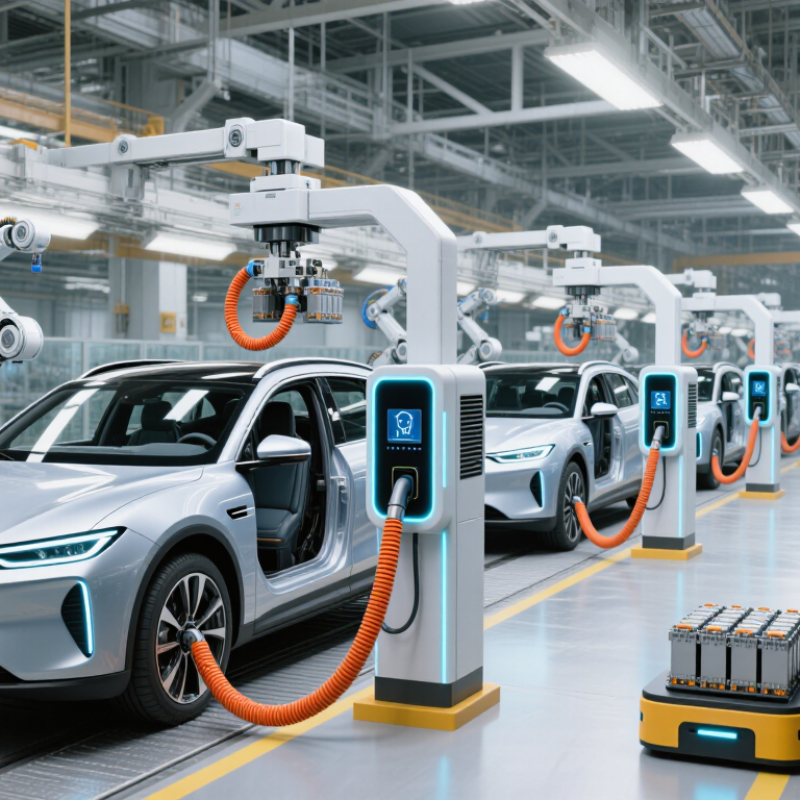
China Best EV Production Line Charger Supplier?

What Is an EV Production Line Charger?

China Best EV Production Line Charger Supplier?

What Is an EV Production Line Charger?

An EV production line charger is industrial equipment used to charge electric vehicles during assembly and testing. It delivers controlled electrical power through a cable, connector, and charging cabinet. Unlike a home charger, it supports repeated use, strict testing, and factory production schedules. Technicians may use it after battery installation, during software checks, or before vehicle delivery. The charger can record voltage, current, charging time, and fault codes. These records help engineers confirm battery performance and trace production issues.

A reliable system should match the vehicle platform, battery voltage, factory power supply, and production rhythm. It may also connect with manufacturing software for automatic status updates. Safety features are essential, including insulation monitoring, emergency stops, overcurrent protection, and temperature control. In practical commissioning, small details matter. A connector that feels slightly loose can interrupt an entire test station. Poor cable placement can also create trip hazards. A perfect installation rarely exists, so regular inspection remains necessary.

Tips: Check connector compatibility before purchasing. Confirm charging power with the battery test plan. Keep cables away from walkways and moving equipment. Review charging records every day. If repeated faults appear, investigate the vehicle, charger, and power supply together. Blaming one component too quickly can hide the real problem. Choose equipment with clear manuals, accessible service support, and documented testing procedures. That evidence is more valuable than attractive specifications alone.

China Best EV Production Line Charger Supplier? What Is an EV Production Line Charger?

An EV production line charger is industrial charging equipment used to charge vehicles, battery packs, or automated guided vehicles during manufacturing and end-of-line testing. Power requirements vary according to the production application.

The chart shows representative charging power levels commonly used in EV manufacturing and charging operations. Actual specifications depend on battery capacity, production takt time, electrical infrastructure, and charging protocol.

Key Features of China’s EV Production Line Chargers

China’s EV production line chargers are built for repeated, controlled charging rather than occasional garage use. Their key advantage is adjustable output. Operators can set voltage and current for different battery packs, reducing unnecessary stress during testing. Modular power units also help factories expand capacity without replacing the entire system. Speed matters. Stable charging matters more.

A reliable charger should provide accurate measurement, thermal protection, insulation monitoring, and emergency shutoff. Many systems support communication with factory control software, allowing engineers to record charging time, voltage changes, and fault codes. This data improves traceability during quality inspections. Durable cabinets, cooling channels, and protected connectors are important on dusty production floors. However, advertised efficiency figures may vary under real workloads. Independent testing is still necessary.

From practical installation experience, cable length and connector handling often affect productivity more than expected. A well-designed unit keeps cables off the walking path and supports quick replacement. Clear displays help technicians identify abnormal temperatures before damage occurs. Regular calibration should be scheduled, even when the charger appears normal. No charger is perfect. Software integration can require extra adjustment, especially with older production systems. Buyers should verify local electrical requirements, service response, spare parts, and load performance before making a decision.

How to Evaluate Chinese Charger Suppliers

Choosing a Chinese EV production line charger supplier requires more than comparing online prices. The right evaluation begins with technical compatibility. Check output voltage, current range, connector design, cooling method, and communication protocols. Ask for complete datasheets, wiring diagrams, and test records. A charger that works in a showroom may fail beside a dusty assembly line.

Request a factory audit or a live video inspection. Look for controlled testing areas, calibrated instruments, component traceability, and trained technicians. Review certification documents carefully, including their issuing bodies and valid dates. Ask how the supplier handles firmware updates, fault alarms, spare parts, and response times. A reliable supplier should provide clear warranty terms and practical installation guidance. Get a sample unit before ordering production quantities. Measure charging stability during repeated cycles.

Price still matters, but it should not lead the decision. Compare total ownership costs, including energy efficiency, maintenance, downtime, and replacement parts. Speak with recent industrial customers when possible. Their experience may reveal delays that brochures hide. No evaluation is perfectly clean. I would still question unusually fast delivery promises or vague answers about safety testing. Small communication gaps can become expensive problems later. Build a written acceptance checklist, and make both sides sign it before production begins.

Manufacturing Standards and Quality Control

China Best EV Production Line Charger Supplier? Manufacturing Standards and Quality Control

Choosing a China-based EV production-line charger supplier requires more than comparing price and output. The factory should document ISO 9001 controls, IEC 61851 requirements, electrical safety testing, and component traceability. The IEA’s Global EV Outlook 2024 reported nearly 14 million electric car sales in 2023. It also recorded more than four million public charging points worldwide. This growth increases pressure on stable power conversion, thermal protection, and repeatable assembly.

Quality control should begin with incoming inspection. Technicians can verify semiconductors, cables, connectors, and insulation materials before production starts. During assembly, automated optical inspection can detect solder defects. Each charger should receive insulation resistance, grounding, overload, communication, and temperature tests. A controlled aging test is useful. It exposes weak units before shipment. The supplier should provide calibration records, failure analysis, corrective actions, and batch-level serial tracking. Independent audits should verify these records, not merely accept them.

No factory is flawless. A claimed 100% first-pass rate deserves questions. Real production includes occasional defects, operator variation, and software updates. What matters is transparent measurement and fast correction. The IEA’s Global EV Outlook 2024 also noted that public charging expansion must accelerate to support rising electric vehicle adoption. Suppliers therefore need documented process capability, trained inspectors, spare-parts planning, and clear acceptance criteria for every charger delivered.

Selecting the Right Supplier for Your EV Factory

China Best EV Production Line Charger Supplier?

Selecting the right supplier starts with your factory’s production rhythm, not a catalogue. The IEA’s Global EV Outlook 2024 reports more than 14 million electric car sales in 2023. It also recorded over 40% growth in public charging points. This pressure reaches assembly plants, where charger downtime can stop a vehicle line within minutes.

Ask suppliers for measured data from comparable factories. Check output stability, connector temperature, power quality, and recovery time after faults. A charger should support relevant IEC 61851 requirements and, where needed, ISO 15118 communication. Request factory acceptance tests using your actual battery voltage range. Watch the screen during testing. Alarm messages should be clear, not hidden inside technical menus. Spare modules, remote diagnostics, and response times should appear in the service agreement.

Do not select only by purchase price. A lower-cost unit may consume more electricity or require frequent manual resets. The U.S. Department of Energy’s Alternative Fuels Data Center shows that charging performance depends on equipment, site power, and operating conditions. That lesson applies inside factories, too. Leave space around cabinets for airflow and maintenance access. A perfect specification is unrealistic. Your team may still overlook cable handling or night-shift training. Run a pilot line for several weeks, record every interruption, and let production operators challenge the supplier’s claims. Reliability is proven on the factory floor.

FAQS

What is an EV production line charger?

It is industrial equipment for charging electric vehicles during assembly and testing. It supplies controlled power through a cable, connector, and charging cabinet.

How does it differ from a home charger?

It supports repeated factory use, strict testing, and scheduled production cycles. It can also record voltage, current, charging time, and fault codes.

When is the charger used during vehicle production?

Technicians may use it after battery installation, during software checks, or before delivery. Each stage can require different charging settings.

What technical details should buyers check?

Confirm battery voltage, output current, connector type, cooling method, and communication protocols. The charger must match the vehicle platform and factory power supply.

Which safety features are important?

Look for insulation monitoring, emergency stops, overcurrent protection, and temperature control. Keep cables away from walkways and moving equipment.

How can a supplier be evaluated?

Request datasheets, wiring diagrams, test records, and certification documents. A factory audit or live video inspection can reveal testing conditions.

Should buyers request a sample unit?

Yes. Test repeated charging cycles and measure stability before placing a larger order. A showroom demonstration may not reflect dusty production conditions.

How should total cost be compared?

Consider energy efficiency, maintenance, spare parts, installation, and downtime. A low purchase price can become expensive when faults interrupt production.

What should an acceptance checklist include?

Record charging limits, connector compatibility, alarm functions, response times, warranty terms, and delivery requirements. Both sides should sign it before production starts.

What common mistakes should buyers avoid?

Do not blame the charger too quickly when faults repeat. Check the vehicle, power supply, cable, and charger together. Small gaps matter.

Conclusion

An EV Production Line Charger is a specialized charging system designed to support electric vehicle manufacturing, testing, and quality inspection on the factory floor. Unlike standard commercial chargers, it is built for continuous operation, stable power delivery, flexible installation, and compatibility with different battery and vehicle platforms. Chinese suppliers often provide solutions with adjustable output, intelligent monitoring, safety protection, efficient thermal management, and customized communication interfaces to meet varied production requirements.

When evaluating a Chinese charger supplier, EV manufacturers should review production capacity, engineering support, certification, quality-control procedures, and after-sales service. Attention should also be given to component consistency, testing records, system durability, delivery reliability, and the supplier’s ability to provide installation guidance and maintenance support. The right supplier should offer a charger that matches the factory’s voltage, power, workflow, space, and future expansion plans while maintaining safe and dependable performance throughout the production process.

Amelia

Amelia

Amelia is a dedicated marketing professional with a strong understanding of the company’s products, customers, and industry landscape. With a thoughtful, research-driven approach, she transforms complex product information into clear, practical, and engaging content that helps readers make informed......