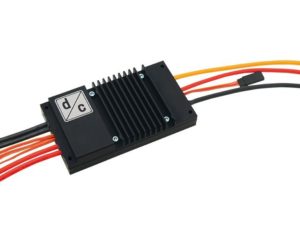
 D-Sinus 120
- Input Voltage: 10 VDC – 16.5 VDC
- Sensorless, sinusoidal commutated drive
- High starting torque & high-level synchronization
- Soft, steady, and silent motor execution
- Up to 95% system efficiency

Sensorless, ultra-quiet BLDC motor speed regulators engineered in Germany for high system efficiency and zero torque ripple.
Traditional block-commutated BLDC drives often suffer from torque ripple, acoustic resonance, and mechanical vibration. Deutronic D-Sinus motor controllers synthesize pure sinusoidal motor currents, enabling exceptionally smooth running, reduced thermal losses, and noise-free operation across demanding industrial duty cycles.
Continuous sine-wave current excitation eliminates torque step-changes, providing quiet, vibe-free motor rotation ideal for pumps, medical equipment, and electric vehicles.
Advanced sensorless control algorithms eliminate vulnerable Hall sensors or shaft encoders, decreasing system failure rates and simplifying physical cable harnesses.
High-efficiency switching stages combined with optimized phase regulation achieve combined drive train (controller + BLDC motor) efficiencies up to 95%.
Flat housing profiles and high power density allow seamless integration into tight package spaces, OEM motor assemblies, or decentralized pump units.
Select from standalone potted speed controllers or integrated microcontrollers for customized brushless DC motor setups.
D-Sinus 120
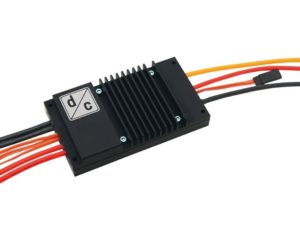 D-Sinus 180
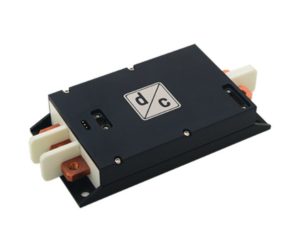 D-Sinus 350
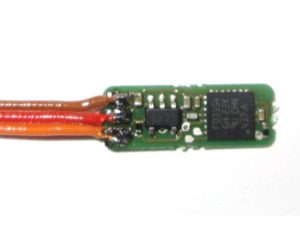 D-MIC Integrated
Compare electrical parameters across the standard Deutronic motor speed regulator portfolio.
| Series Model | Input Voltage Range | Commutation Mode | Sensor Type | Max System Efficiency | Primary Application Focus |
|---|---|---|---|---|---|
| D-Sinus 120 | 10 - 16.5 VDC | Pure Sinusoidal | Sensorless | Up to 95% | Decentralized 12V fluid pumps & fans |
| D-Sinus 180 | 10 - 16.5 VDC | Pure Sinusoidal | Sensorless | Up to 95% | High-torque actuators & vehicle drives |
| D-Sinus 350 | 10 - 22.5 VDC / 58 VDC | Pure Sinusoidal | Sensorless | Up to 95% | Industrial automation & mobile machinery |
| D-MIC | 10 - 33 VDC / 80 VDC | Sinusoidal / Custom | Sensorless / Embedded | Up to 94% | Direct motor-integrated OEM smart drives |
From silent cabin climate actuators to reliable heavy-duty hydraulic cooling systems, Deutronic motor control units are field-proven in extreme environments.
Continuous duty cycle coolant, lubricant, and fuel delivery pumps requiring smooth velocity control without cavitation or audible hum.
Compact drive systems requiring low power consumption, quiet operation in automated warehouses, and high starting torque for load movement.
Variable-speed HVAC blowers in commercial vehicles, passenger trains, and cleanroom installations where acoustics are strictly regulated.
Tailored motor drive boards produced via our PCB contract manufacturing line, fully potted to survive shock, oil, and moisture exposure.
Sinusoidal commutation regulates the motor phase currents in smooth continuous sine waves rather than harsh step switches. This eliminates torque ripple, eliminates motor humming and audible noise, significantly reduces mechanical vibration, and improves total energy efficiency.
No. Deutronic D-Sinus controllers operate sensorlessly using high-speed digital algorithms that calculate rotor position from back-EMF feedback. This removes physical sensors, reduces cabling costs, and improves long-term reliability in high-temperature or high-vibration applications.
Yes. Deutronic engineers develop firmware and hardware under one roof in Germany. We precisely tune acceleration curves, current limits, speed ranges, and interface protocols to match your specific motor parameters and application requirements.
Absolutly. Because in-house PCB assembly (SMD/THT), potting, mechanical assembly, and end-of-line testing are performed in-house, we can adapt housing geometry and potting compounds even for specialized series volumes.
Contact our power electronics engineers to discuss your operating voltage, motor inductance, peak current demands, and mechanical package constraints.