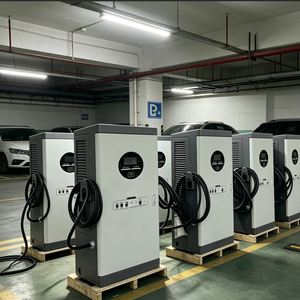

Engineered for extreme duty cycles, rugged railway environments, and municipal fleet electrification across Toronto and the Greater Golden Horseshoe region.
The Greater Toronto Area (GTA) is undergoing one of the largest transit infrastructure transformations in North America. With multi-billion-dollar investments spanning Metrolinx’s GO Rail Expansion Program, the Toronto Transit Commission (TTC) light-rail expansion, and Ontario Line subway construction, the regional demand for ultra-reliable railway DC DC converters has reached an unprecedented peak. Modern rolling stock, light-rail vehicles (LRVs), automated people movers (APMs), and trackside signal networks require power conversion systems that maintain peak efficiency under harsh environmental and electrical operational constraints.
Railway power networks do not operate like conventional stationary microgrids. Auxiliary systems—such as on-board HVAC, brake control electronics, passenger communications, door actuators, and emergency lighting—rely on DC/DC converters to step down high nominal catenary voltages (ranging from 600VDC, 750VDC, to 1500VDC) down to safe, regulated low-voltage buses (24VDC, 48VDC, or 110VDC). As a specialized engineering partner and manufacturer serving the Toronto market, our mission is to deliver galvanically isolated, contact-cooled DC/DC converters built specifically to withstand Ontario's sub-zero winter temperatures, severe mechanical shock, and intense electrical surges.
Combining planar magnetics, robust thermal management, and intelligent CAN communications to eliminate single-point operational failures.
Supports nominal inputs from 24VDC up to 900VDC (and custom 1500VDC platforms), accommodating extreme catenary voltage dips and high-energy transient spikes without shutting down.
Eliminates failure-prone fans and complex liquid lines. Power components dissipate heat directly into the vehicle's chassis frame via advanced aluminum baseplates.
Reinforced galvanic isolation up to 3.0kV AC / 4.2kV DC between input, output, and chassis ground to protect sensitive microcontrollers and human operators.
Integrated real-time parameterization, remote diagnostics, dynamic output voltage scaling, and active fault reporting directly into the Train Control and Management System (TCMS).
Fully encapsulated electronics using specialized polyurethane/epoxy compounds resist dust, moisture, salt spray (de-icing chemicals), and EN 61373 Category 1 Class B shock loads.
A frequent mistake in transit infrastructure procurement is deploying standard off-the-shelf industrial power supplies in rolling stock environments. Rail applications expose electrical components to continuous vibration, high humidity, conductive track dust, and wide input voltage fluctuations. The comparison table below highlights why dedicated railway-grade conversion units are mandatory for Toronto municipal projects.
| Specification Parameter | Standard Industrial DC Converter | Deutronic Railway-Grade DC DC Converter | Toronto Transit Impact Benefit |
|---|---|---|---|
| Compliance Standards | UL 60950 / IEC 62368-1 | EN 50155, IEC 60571, EN 45545-2 | Mandatory for Metrolinx & TTC procurement compliance. |
| Input Voltage Tolerance | ±10% to ±20% Nominal | 0.60 to 1.40 UN (Continuous) + Surge | Prevents resets during catenary sag and regenerative braking peaks. |
| Thermal Range | -10°C to +50°C (Fan Cooled) | -40°C to +85°C Class TX (Contact Cooled) | Guarantees winter cold-boot reliability in GTA yards. |
| Shock & Vibration | Basic Commercial Handling | EN 61373 Category 1 Class B (Body Mounted) | Eliminates solder joint fatigue from continuous rail vibrations. |
| Fire & Smoke Safety | UL94 V-0 Plastics | EN 45545-2 (HL2 / HL3 Hazard Levels) | Non-toxic emission protection inside tunnel environments. |
| Cooling Topology | Forced Air / Rotating Fans | Passive Baseplate Contact Cooling | Zero moving parts; eliminates maintenance intervals. |
Toronto's continental climate presents a unique engineering dual-challenge: severe winter temperatures dropping below -30°C followed by summer heat waves pushing ambient temperatures inside unconditioned equipment bays above +60°C. Conventional converter designs relying on electrolytic capacitors and fan forced-air cooling suffer rapid degradation under these conditions.
Our railway converter platform (including the flagship DVCx3 and high-voltage DVCHx3 series) utilizes planar transformers integrated directly into multi-layer heavy-copper printed circuit boards (PCBs). By replacing bulky wound wire inductors with planar geometry, we achieve:
While some high-power converters opt for liquid cooling loops, contact cooling (conduction through chassis baseplate) remains the preferred standard for auxiliary conversion units up to 10kW. Liquid cooling adds pumps, coolant lines, risk of fluid leaks near high-voltage circuits, and freezing risks during winter storage. Contact cooling utilizes the structural steel or aluminum frame of the rail vehicle as an infinite heatsink. By potting internal components in thermally conductive resins, heat generated by planar transformers and power switches is efficiently drawn away, guaranteeing continuous operation without airflow dependencies.
As GO Transit transitions its diesel fleet to electric locomotives and EMU (Electric Multiple Unit) trains, reliable low-voltage control power is essential. Our high-voltage DC/DC converters step down elevated traction power to supply critical safety systems: positive train control (PTC), emergency battery charger units, door control systems, and cab signaling apparatus.
The Toronto Transit Commission operates extensive 600V/750V DC surface rail networks. Electrical noise and voltage fluctuations caused by sub-station switching and regenerative braking are notorious. Deutronic’s contact-cooled units act as a robust buffer, delivering ultra-stable 24VDC or 110VDC output to onboard passenger Wi-Fi, HVAC dampers, LED destination signs, and fare collection terminals.
Automated airport transit systems demand 99.999% operational availability. In maintenance facilities and trackside wayside enclosures, our industrial DIN-rail and potted power supplies supply uninterrupted power to wayside sensors, point-machine switches, and automated platform screen doors.
With over three decades of in-house research, development, and manufacturing leadership based in Adlkofen, Germany—and expanded regional operations across North America—Deutronic Elektronik GmbH stands as a global authority in power conversion and automated testing systems.
From initial circuit simulation and high-voltage PCB layout to SMD assembly, potting, enclosure machining, and automated end-of-line testing—100% of processes remain under unified quality management.
Every single converter unit undergoes full burn-in and functional evaluation using our proprietary Deutronic Test Software (DTS) platform, generating complete serial-number-traceable test reports for municipal auditors.
We offer tailored mechanical enclosures, custom pinouts, non-standard input ranges, and specific CAN / J1939 communication matrices for low-to-medium series production volumes.
Detailed technical answers to common integration, procurement, and certification questions.
Our railway converter platforms are split into low-voltage and high-voltage families. The DVCx3 series covers input ranges up to 300VDC, while the DVCHx3 series operates across high-voltage inputs from 300VDC up to 900VDC continuously (with custom solutions engineering up to 1500VDC). This fully accommodates standard 600V, 750V, and 1200V traction networks used in GTA light rail and heavy rail corridors, including tolerance against EN 50155 surge transients.
All Deutronic railway-grade converters are built using industrial-extended or automotive-grade active components rated for -40°C to +125°C junction temperatures. Special internal potting materials prevent micro-cracking of solder joints due to thermal expansion/contraction, and power stages are parameterised for reliable cold-boot starting without requiring internal heater elements.
Yes. Our dedicated transportation power converters comply with EN 50155 (electronic equipment used on rolling stock) covering operational temperature, shock/vibration (EN 61373), and electromagnetic compatibility. Furthermore, all potting compounds, printed circuit boards, and connectors meet EN 45545-2 Hazard Level HL2/HL3 requirements for smoke generation and toxicity, making them safe for underground subway operations like the TTC lines.
Absolutely. Integrated CAN 2.0B interfaces supporting standard CANopen or SAE J1939 protocols allow real-time monitoring of internal baseplate temperatures, input/output voltages, current draw, and fault history. Output voltages can also be dynamically adjusted via software commands to support intelligent battery charging regimes.
Forced air cooling requires fans, which are the #1 mechanical point of failure in power electronics. Fans draw in metallic dust, moisture, and road salt from track beds, leading to short circuits. Baseplate contact cooling transfers heat directly to the vehicle chassis frame, resulting in an IP65/IP67 sealed enclosure with zero moving parts, zero maintenance requirements, and MTBF values exceeding 500,000 hours.
Yes. Because we control complete design, PCB manufacturing, metal machining, and potting in-house, we routinely engineer custom mounting brackets, connector interface plates, and form-factor drop-in replacements for legacy railcars being overhauled by transit operators.
Partner with a certified global manufacturer for your Toronto rail infrastructure, fleet electrification, or custom DC conversion project. Speak directly with our senior application engineers today.
Get a Quote