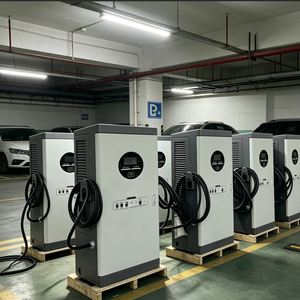
Explore our certified, high-performance DC fast charging stations designed for fleets, public networks, and OEM commercial deployments worldwide.
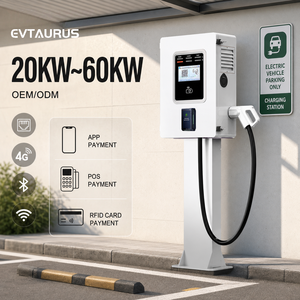
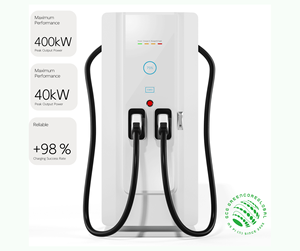
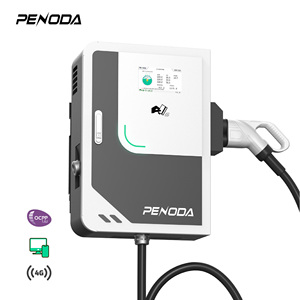
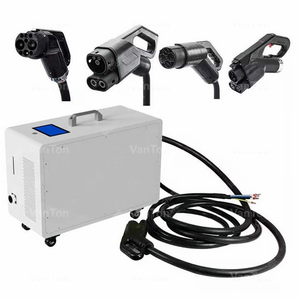
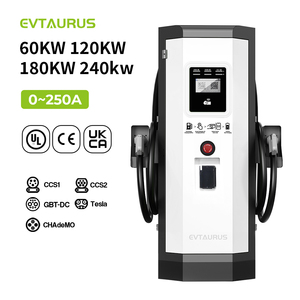
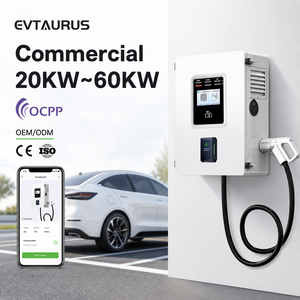
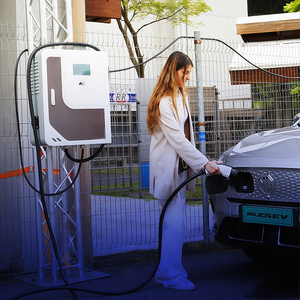
As global transport electrification accelerates toward 2030, global CPOs (Charge Point Operators), commercial fleet operators, and hardware distributors face escalating challenges in selecting qualified manufacturing partners. Navigating China’s vast ecosystem of station charger suppliers requires looking beyond basic datasheets into deep power electronics topology, thermal control engineering, component-level traceability, and protocol compliance frameworks.
China has established itself as the world’s most vertically integrated production hub for electric vehicle supply equipment (EVSE). However, achieving industrial reliability—defined as maintaining 99.5%+ uptime over a 10-year service life—demands strict alignment between original design specifications and real-world industrial execution. Combining robust OEM manufacturing scale with high-precision engineering standards (inspired by German power-electronics principles like potted power supplies, contact-cooling, and DTS automated test software), top-tier Chinese factories now deliver benchmark solutions across 15kW to 240kW+ power nodes.
Core Procurement Insight: The true cost of ownership (TCO) in commercial EV infrastructure is dominated by post-deployment maintenance and grid downtime. Leading station charger factories leverage Silicon Carbide (SiC) MOSFET power conversion modules and isolated CAN bus architectures to achieve operational lifespans exceeding 100,000 hours MTBF (Mean Time Between Failures).
Modern fast-charging station architecture relies on modular power conversion cabinets. Traditional power modules utilized silicon IGBT switches limited to switching frequencies around 20 kHz, resulting in larger inductive components, higher thermal dissipation, and peak conversion efficiencies capped at ~95%. Premier Chinese suppliers have transitioned to 30kW and 40kW high-frequency SiC MOSFET power modules.
By operating at switching frequencies above 100 kHz, SiC-based power converters reduce module volume by up to 40% while raising energy conversion efficiency to 97.5%–98%. For a 240kW highway fast-charging plaza, a 2.5% efficiency gain eliminates thousands of kilowatt-hours in parasitic heat losses annually, directly slashing utility costs and reducing forced-air cooling noise.
Ultra-wide output voltage range (200V–1000V DC) delivering constant full-power charging to both standard 400V passenger EVs and modern 800V heavy commercial fleets.
Potting-encapsulated internal power supplies and contact-cooled sub-assemblies protect critical control PCBs against dust, salt mist, and extreme humidity.
Seamless execution of Plug & Charge digital certificates, TLS 1.3 encrypted communications, and smart grid dynamic load management protocols.
To assist technical buyers in evaluating station charger factory outputs, the following matrix categorizes standard commercial hardware platforms engineered by top-tier suppliers:
| Charger Category | Power Output | Input / Output Voltage | Protection & Thermal | Primary Deployment Scenario |
|---|---|---|---|---|
| DC Wallbox / Movable | 15kW - 40kW | 3-Phase 380V±15% / 200V-750V DC | IP55 / Force Air Cooled | Commercial Fleets, Auto Dealerships, Workshop Diagnostics |
| Compact Commercial DC | 60kW - 80kW | 3-Phase 400V±15% / 150V-1000V DC | IP55 / Contact + Forced Air | Retail Centers, Public Urban Charging, Workplace Parking |
| High-Power Dual Stand | 120kW - 240kW | 3-Phase 400V±15% / 150V-1000V DC | IP55/IP65 / Modular Power Matrix | Highway Service Stations, Logistics Hubs, Bus Terminals |
| Liquid-Cooled Megawatt | 360kW - 480kW+ | 3-Phase 400V±15% / 200V-1000V DC | IP65 Enclosure / Liquid Cable Cooling | Ultra-Fast Highway Hubs, Heavy-Duty E-Truck Corridors |
Purchasing directors must align current tender requirements with emerging technological shifts. Over the next decade, the EVSE supply chain will experience fundamental shifts driven by battery chemistry advancements, grid congestion, and sovereign cybersecurity standards.
Mainstream passenger vehicles are rapidly transitioning from 400V battery architectures to 800V silicon-carbide native platforms (enabling 10% to 80% state-of-charge top-ups in under 15 minutes). EV charger manufacturers in China are standardizing output voltage envelopes to 150V–1000V DC across all commercial station models, eliminating current bottlenecks and preventing premature equipment obsolescence.
Legacy dual-connector chargers utilized fixed power splitting (e.g., a 120kW charger locked at 60kW+60kW). Advanced station chargers feature intelligent dynamic matrix switching. When a single vehicle connects, the system route all 120kW to one gun; when a second vehicle arrives, power matrix modules re-allocate energy dynamically based on real-time BMS request curves (e.g., 90kW + 30kW). This maximizes asset utilization rates for site hosts.
As grid capacity constraints tighten globally, future-proof procurement strategies favor chargers capable of bidirectional power flow (Vehicle-to-Grid / V2G) or stations natively interfaced with Battery Energy Storage Systems (BESS). Integrated microgrid chargers buffer peak demand charges by drawing from local storage batteries during high-tariff periods, releasing energy to EVs without expensive utility grid transformer upgrades.
Leveraging state-of-the-art production infrastructure, our manufacturing partners synthesize high-volume Chinese industrial scaling with strict engineering quality control systems. Rooted in rigorous power-electronics principles, our quality assurance framework ensures every station charger withstands harsh operating environments.
Complete control over core controller circuit boards. Automatic optical inspection (AOI), conformal coating for anti-vibration, and rigorous environmental stress testing ensure zero-defect electronics.
Every completed charging computer undergoes fully automated End-of-Line (EOL) electrical safety, insulation resistance, ground bond, and thermal burn-in testing under simulated full load prior to packing.
Fully compliant with CE, IEC 61851, IEC 62196, ISO 15118, DIN 70121, CHAdeMO, and GB/T standards. Equipped with MID-certified metering for billing compliance across EU & global markets.
Below are authoritative responses to critical technical and logistical questions faced by global procurement teams when sourcing commercial EV chargers from China factories.